The Social Taboo Against Women Painting or Writing
To the LighthouseThe Social Taboo Against Women Painting or Writing takes shape in the refrain Charles Tansley directs at Lily Briscoe: “Women can’t paint, women can’t write ...” The claim is more than an insult; it gives a blunt form to a social rule that tries to disqualify women’s creative work. Lily recognizes its injustice, yet feels its force in her body and attention, so that painting becomes both an artistic problem and a struggle to resist the judgment that shadows it.
The Claim and Its Force
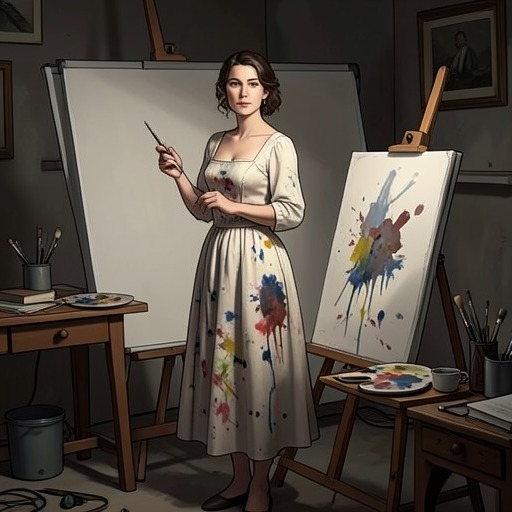
Tansley’s words surface as Lily looks at a canvas that seems to her painfully inadequate to what she sees. She imagines how another painter, Paunceforte, might have softened and etherealised the colour and forms, but rejects that solution: her own vision is of colour burning on a steel framework, with the light of a butterfly’s wing on cathedral arches. On the canvas, however, only a few random marks remain. The gap between the intensity of her perception and the marks she has managed to make sharpens the vulnerability that Tansley’s refrain exploits.
The sentence is presented as something Lily hears whispered in her ear, not as an impersonal rule announced by an institution. Its quiet repetition makes the prohibition intimate: it enters the moment when she is judging her own work and helps turn dissatisfaction into a verdict on whether women can create at all. Yet the scene does not treat that verdict as truth. The force of the taboo lies in its capacity to burden the artist, not in any demonstrated lack of ability.
Lily’s Response to Tansley
Later, Tansley declares that the family will not go to the Lighthouse the next day, asserting himself in a social gathering whose conversation he considers superficial. Lily finds him profoundly uncharming, but recognizes that his opinion still affects her. His claim about women’s painting and writing rises again in her thoughts, and she asks why her whole being bows beneath it, like corn under wind, before laboriously righting itself.
That inward recoil is followed by a deliberate effort to recover her attention. Lily fixes on the sprig on the tablecloth and on her painting, deciding that moving the tree to the middle matters more than arguing with Tansley. She considers taking revenge by laughing at him rather than losing her temper. Her reply asks him to take her to the Lighthouse, though she does not mean it; she knows she is teasing him. The exchange shows resistance as neither effortless confidence nor a simple public victory: she remains affected by his words, but tries to redirect their power through attention to her work and a knowingly false, playful response.
The Taboo as Social Authority
Tansley’s own conduct exposes the narrowness of the authority behind his pronouncement. He arrives at the gathering in ordinary clothes because he has no dress clothes, regards the women’s talk and social rituals with contempt, and blames women for making civilisation impossible through their charm and silliness. His assertion about women’s capacities belongs to this larger pattern of resentment and self-assertion. Lily, in turn, sees that the claim is not something he has established by judging her work fairly; she suspects it is useful to him for some reason.
The episode therefore distinguishes the social effectiveness of a rule from its credibility. Lily knows that Tansley’s statement does not make her painting false, yet she cannot simply prevent it from entering her judgment of herself. The taboo operates through repeated discouragement and the pressure to treat a man’s dismissive opinion as consequential. Against it, the canvas remains a concrete task: Lily must make the colour and forms move according to her own vision, rather than accept someone else’s account of what women can do.